

This offsets last post on OJ. The system has reversed that trade with a Long entry in the May contract (K5) at 1.1985 on 3/9/15. See the last ‘blue’ arrow on the screenshot below. Last Short Entry posts up a loss of $465/contract
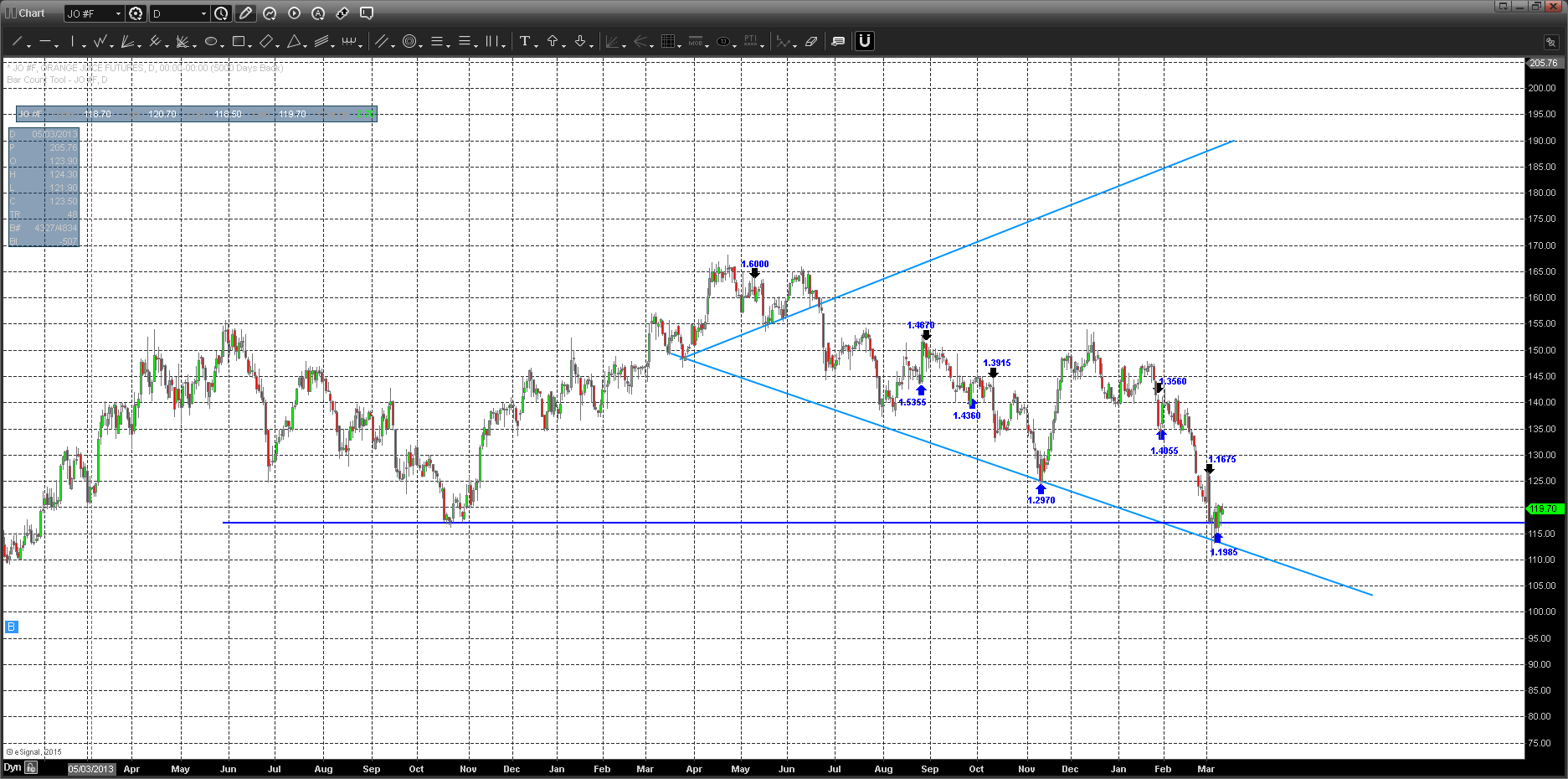
The program trades as a ‘stop and reverse’ (SAR) order entry. The OJ trade has been choppy and has statistically under-performed its historical metrics over the past 8 years. One of the things I look for when determining whether asset behavior ‘fits’ the design of the momentum indicator I’ve developed is signal-resilience; over large sample sizes, systems will draw down as market conditions change, and that’s to be expected. You need to ensure that if you’re trading trends on day charts or higher time frames (weekly, monthly) — the greater the holding period, the greater the risk, because by default you are holding through bigger market swings, unless you have systematized the money management filter (ie., Martingale, etc). I do not have an incremental money management protocol….I lock in my size when the signal goes off. I’m also trading shorter duration swings (days to weeks). By the time the trader reaches desirable ‘unit’ exposure, the trade may expire, and so in the process you’ve increased your average cost basis, risk and potential to swing into loss (assuming you’re profitable to begin with). So here, I standardize position size/asset, on the basis of asset Vol. Back to OJ metrics and determining asset performance on backtesting: you need to find a balance between Winning % and Signal Frequency. It’s not all about Win rate. You may be winning 80% on your backtest, but if you’re infrequently trading (weeks to months/signal), your going through some moderate P/L swings. That may feel ok when looking through a backtest report — try holding on to those positions that get away from you and draw you down …..its a different emotional experience and you likely will not be holding on. And the purpose of systematizing and swinging/trend trading is not to ride the rollercoaster of emotions every trade. So you need to blend your Win Rate with Signal Frequency and Win:Loss ratio. In other words, its more advantageous to win less, but win big relative to losses, which implies the system is getting you out fast when the market goes against you ie., taking small losses, and keeping you in for the big winning swings. My Cotton program, for example wins 35% of trades over 8 years, but its Win:Loss is 4x. In this case, I’m fine getting knicked on 2/3 trades, because statistically the 3rd, or ~33% of the time I will recoup those 2 previous losses and gain 33% in the process, over large sample size.
 Futures Trading